
Composite Veneers in Bondi Junction
A conservative way to reshape your smile — tooth-coloured resin shaped directly onto your teeth to change their shape, size, colour or symmetry, often removing little or none of the natural tooth.
Composite Veneers — at a glance
| Material | Tooth-coloured composite resin |
|---|---|
| Treatment | Usually direct, in the surgery |
| Appointments | Often 1–2 |
| Tooth reduction | Little or none in suitable cases |
| Repairable | Often yes |
| Stain resistance | Lower than porcelain |
| Best suited to | Shape, proportion, minor spacing, wear and colour changes |
| Location | Bondi Junction |

Our approach to composite veneers
Composite veneers use tooth-coloured resin to change the shape, proportion, colour or symmetry of the visible teeth. Unlike porcelain veneers, the resin is usually applied and shaped directly onto the tooth — so in suitable cases we can make quite a noticeable change to a smile while removing little, and sometimes none, of the natural tooth underneath.
The aim isn't to make every tooth look identical — it's to work with your face, your smile and your natural teeth to create a result that looks like it belongs to you.
After more than 35 years in dentistry, Dr Brendan Quill's instinct is to reach for the least intervention that achieves the change you want. Sometimes that's composite veneers; sometimes it's whitening, bonding, aligners or porcelain — and we'll tell you so plainly.
What are composite veneers?
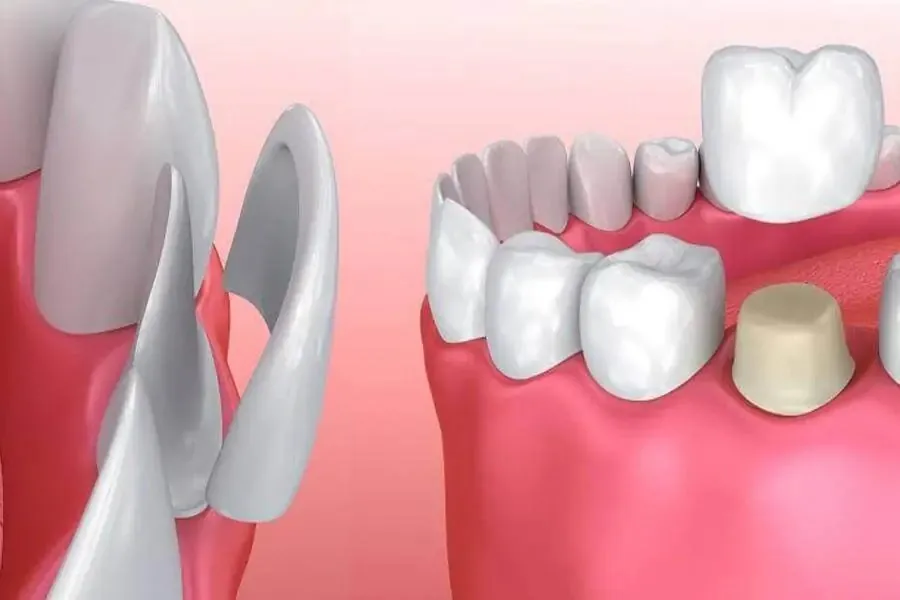
Composite veneers — also known as composite resin veneers or direct composite veneers — are thin layers of tooth-coloured composite resin placed over the front surface of teeth. The material is bonded directly to the tooth and then carefully shaped, contoured and polished by the dentist.
Composite veneers can change several features of a tooth at the same time, including its:
- shape
- length
- width
- colour
- symmetry
- surface appearance
- relationship to neighbouring teeth
Because they are generally created directly in the mouth rather than manufactured separately in a dental laboratory, composite veneers can often be completed in fewer appointments than porcelain veneers. For some people, they also provide a more conservative and affordable way to change their smile.
What can composite veneers improve?
Composite veneers can be useful when you want to make a broader cosmetic change than repairing one small chip or edge. We may consider them for:
- uneven or irregularly shaped teeth
- worn front teeth
- small gaps between teeth
- teeth that appear too short
- minor differences in tooth size
- chipped or damaged front teeth
- discolouration that whitening cannot fully correct
- minor asymmetry across the smile
- several cosmetic concerns affecting the same teeth
They can also be useful when several teeth need to be brought into better proportion with each other. But composite veneers cannot solve every cosmetic problem. Sometimes whitening, clear aligners, composite bonding or porcelain veneers will give a better result with less dentistry or greater predictability. That is why we start with your smile rather than starting with a particular treatment.
Cosmetic dentistry doesn't have to mean removing healthy teeth
One of the most common questions people ask about veneers is: "Will you have to shave my teeth down?" The answer depends on the type of veneer, the position of your teeth and the change you are trying to make.
With direct composite veneers, resin is added to the existing tooth. Where there is enough room to create the desired shape without making the teeth look bulky, little or no natural tooth may need to be removed. In other situations, a small amount of reshaping may be appropriate. That makes composite veneers particularly interesting for people who want to improve their smile while preserving as much natural tooth structure as reasonably possible. If we can achieve the result you want with less intervention, that is usually where we start.
Composite veneers or composite bonding?
The two treatments use the same broad family of tooth-coloured resin, so the terminology can sometimes be confusing. The main difference is the extent of the change.
Composite bonding
Composite bonding usually makes a relatively small, localised change to a tooth — for example, repairing a chipped corner, closing a small gap, smoothing a worn edge or slightly altering the shape of one tooth.
Composite veneers
A composite veneer covers much more of the visible front surface of the tooth. Rather than fixing one detail, it can change several things at once — such as the tooth's overall shape, length, width, proportion and colour.
A simple way to think about the distinction: bonding changes a detail; a composite veneer changes more of the visible tooth. There isn't always a hard dividing line between the two, and dentists sometimes use the terms differently. What matters is how much of the tooth is being rebuilt and what we are trying to achieve. Our composite bonding page explains the smaller-scale option in more detail.
Composite veneers or porcelain veneers?
For many patients, this is the more important comparison. Both materials can create attractive results, but they have different strengths and different trade-offs.
Composite veneers
Composite resin is generally shaped directly onto your teeth. Potential advantages include:
- little or no tooth reduction in suitable cases
- fewer appointments
- often completed directly in the surgery
- lower initial cost than porcelain
- straightforward to adjust
- easier to repair if a small area chips
- a conservative option for suitable cases
The trade-off is that composite can stain, wear and lose some of its polish over time. It can also be more prone to chipping than porcelain, particularly where there are heavy biting forces or tooth grinding.
Porcelain veneers
Porcelain veneers are thin ceramic restorations individually made to fit the teeth. Their potential advantages include excellent colour stability, strong resistance to staining, predictable shape and surface texture, excellent aesthetics and greater resistance to wear. They are generally more expensive and usually involve more treatment planning, and depending on the case some natural enamel may need to be removed to create room for the veneer. Porcelain is also less straightforward to repair if it becomes damaged.
Which is better?
Neither material is automatically better. If preserving natural tooth structure is a high priority and composite can predictably achieve the result you want, composite veneers can be an excellent option. If you want a substantial change in colour or shape across a number of teeth and long-term colour stability is particularly important, porcelain may make more sense. We'll explain the difference rather than simply recommending the more expensive treatment — our guide to dental veneers compares porcelain and composite in detail.
Who is suitable for composite veneers?
Composite veneers work best when the teeth and gums underneath them are healthy. Before recommending treatment we consider the position of your teeth, your bite, whether you grind or clench, the amount and quality of enamel, existing fillings, gum health, tooth colour, the amount of change you want, and whether orthodontic movement could achieve some of the result more conservatively.
That last point is important. Sometimes teeth look uneven or prominent because of their position rather than their shape, and adding composite to teeth that are already crowded or protruding can make them look bulkier. In those situations, moving the teeth first with clear aligners may allow us to achieve a better result with less restorative dentistry afterwards.
Not sure whether you need bonding or veneers?
Book a relaxed cosmetic assessment and we'll talk you through it.
What happens when you have composite veneers?
Every smile is different, but treatment generally follows several stages.
1. Cosmetic assessment
We start by asking what you actually want to change. Some people have one particular tooth that bothers them; others simply feel their smile looks uneven but aren't quite sure why. We assess your teeth, gums, bite and smile and talk through the options.
2. Planning the shape
Good cosmetic dentistry is largely about proportion. We consider tooth length, width, symmetry, the gum line, the smile line, lip position, the neighbouring teeth and the overall shape of your face. The objective isn't simply to make teeth whiter or larger — it's to make them fit naturally together.
3. Shade selection
We choose a composite shade that works with your existing teeth. If you are considering teeth whitening, it usually makes sense to whiten first, because composite resin itself will not subsequently whiten. We can then match the composite to your new tooth shade.
4. Conservative preparation
Depending on the case, little or no natural tooth may need to be removed. Where minor preparation is needed, we keep it as conservative as reasonably possible.
5. Building the veneers
Composite resin is carefully applied in layers and shaped directly on the teeth. This is where much of the artistry of the treatment happens: small differences in length, curvature, translucency and surface texture can be the difference between teeth that look obviously "done" and teeth that simply look naturally attractive.
6. Finishing and polishing
The veneers are refined, your bite is checked, and the composite is polished to create a smooth, natural-looking surface.
Can composite veneers be done in one appointment?
Sometimes, yes. Because direct composite veneers are built onto the teeth rather than manufactured by a dental laboratory, treatment can often be completed more quickly than porcelain veneers. The number and length of appointments depends on how many teeth are being treated, how extensive the changes are, whether whitening is being carried out first, whether other dental treatment is required, and how much planning is needed. For a larger smile makeover, we may recommend planning treatment over more than one visit rather than rushing the result.
The advantages of composite veneers
They can preserve more natural tooth. Composite is added to the tooth rather than requiring substantial removal of tooth structure — for the right case, one of its biggest advantages.
They are repairable. If a composite veneer develops a small chip, it can often be repaired directly, which may avoid replacing the whole restoration.
They can be adjusted. Composite can be reshaped and polished after placement, giving us flexibility to refine the result.
They can look very natural. Different shades, translucencies, contours and surface textures can be used to retain natural character — they don't have to create an unnaturally white or uniform smile.
They generally cost less than porcelain. For people who'd like to improve several teeth without the cost or commitment of porcelain, composite provides another option.
The disadvantages of composite veneers
Composite veneers do require maintenance. Over time, composite resin can stain, lose some of its original shine, develop small chips, wear at the edges, need repolishing, and eventually require repair or replacement.
Coffee, tea, red wine, smoking and other strongly pigmented foods or drinks can contribute to staining. Biting fingernails or hard objects can increase the chance of chipping, and grinding or clenching can place considerably more force on veneers. If we see signs that you grind your teeth, we'll discuss how this may affect treatment and whether protecting your veneers with a night guard is appropriate.
How long do composite veneers last?
There isn't one meaningful lifespan that applies to everyone. Longevity depends on how many teeth have been treated, where the veneers are placed, the amount of composite used, your bite, whether you grind or clench, your oral hygiene, diet, habits such as nail biting, and ongoing maintenance.
Composite is not as resistant to wear and staining as high-quality ceramic. On the other hand, its ability to be repaired is one of its advantages. It's more realistic to think of composite veneers as restorations that may occasionally need polishing, maintenance or repair rather than something that will never require attention again.
Will composite veneers look bulky?
They shouldn't — but this is one of the reasons proper treatment planning matters. If composite is simply added onto teeth without considering their existing position and proportions, the result can look too thick or prominent. Before recommending composite veneers, we look at whether there is physically enough room to create the desired shape. For crowded or prominent teeth, orthodontic movement may sometimes produce a better and more natural-looking result than simply adding more material. We'd rather recommend less restorative treatment than create a smile that doesn't look right.
Considering composite or porcelain?
We'll show you the difference before you decide — no pressure.
Can composite veneers look natural?
Absolutely — and for us, that's the point. Natural teeth aren't perfectly flat, perfectly symmetrical or one uniform block of colour; they have subtle differences in translucency, gentle variations in shape, surface texture, rounded edges and slight differences from tooth to tooth. Our preference is generally for cosmetic dentistry that doesn't announce itself. People should notice your smile — they don't necessarily need to notice your dental work.
Can composite veneers make my teeth whiter?
Yes, composite can change the visible colour of a tooth. But if your main concern is simply that your teeth look dark or yellow, professional teeth whitening may be a much simpler treatment. Whitening preserves all of the natural tooth and should generally be considered before adding restorative material purely to change colour. If you want both a brighter colour and changes to tooth shape, we may recommend whitening first and then matching your composite veneers to the new shade.
Do composite veneers damage your teeth?
Composite veneers can be one of the more conservative cosmetic dental treatments, because the material is bonded onto the existing tooth and in suitable cases little or no tooth structure needs to be removed. However, no dental procedure should be described as completely consequence-free: the tooth surface needs to be prepared appropriately for bonding, and some cases require minor reshaping. The important question is how much healthy tooth has to be altered to achieve the desired result — and our preference is always to preserve as much natural tooth structure as reasonably possible.
How much do composite veneers cost?
The cost of composite veneers depends mainly on how many teeth are being treated, how extensively each tooth needs to be reshaped, the complexity of the smile design, and whether any preliminary treatment is required. Composite veneers are generally less expensive than porcelain veneers because they can be created directly rather than individually manufactured as ceramic restorations. After assessing your teeth and discussing what you'd like to change, we'll explain the options and provide clear pricing before you decide whether to proceed. There is no obligation to go ahead.
Composite veneers near you in Bondi Junction
If you're searching for composite veneers near you in Bondi Junction or Sydney's Eastern Suburbs, Dentist In The Park is conveniently located in central Bondi Junction at Suite 402, 3 Waverley Street, Bondi Junction NSW 2022. We see patients from Bondi Junction and surrounding areas including Bondi, Waverley, Woollahra, Bellevue Hill, Double Bay, Edgecliff and the wider Eastern Suburbs. Bondi Junction train station and bus interchange are also nearby.
Why choose Dentist In The Park for composite veneers?
Cosmetic dentistry is not just about technical dentistry — it involves judgement. How much should we change? How white should the teeth be? Should that gap disappear entirely? Would slightly different tooth lengths look more natural? Can we achieve the result without removing healthy enamel? And would orthodontics, whitening or simple composite bonding actually be a better option?
Principal dentist Dr Brendan Quill has more than 35 years' experience across general, restorative, orthodontic and cosmetic dentistry. That breadth matters, because veneers aren't the only treatment available. Our starting point is not "how many veneers can we place?" — it's "what is the simplest and most conservative way to create the change you want?" Sometimes that's composite veneers; sometimes porcelain; sometimes clear aligners followed by a little composite bonding; sometimes all you really need is teeth whitening. We'll explain the differences and help you decide what makes sense for you.
Composite veneers near me
If you've searched for composite veneers near me, convenience is a real plus — composite work is often completed in a single visit and can usually be adjusted or repaired later, so a nearby dentist you can drop back to is genuinely useful.
Our Bondi Junction practice is easy to reach from Bondi, Waverley, Woollahra, Bellevue Hill and the wider Eastern Suburbs.
Frequently asked questions
What are composite veneers made from?
Are composite veneers the same as composite bonding?
Are composite veneers cheaper than porcelain veneers?
Do composite veneers require teeth to be shaved down?
Can you get composite veneers without drilling your teeth?
Are composite veneers permanent?
How long do composite veneers last?
Do composite veneers stain?
Can composite veneers chip?
Can composite veneers close gaps?
Can composite veneers fix crooked teeth?
Should I whiten my teeth before having composite veneers?
Are composite veneers suitable for people who grind their teeth?
Where can I get composite veneers near me in Bondi Junction?

Your cosmetic dentist
Composite veneers at Dentist In The Park are shaped by hand by Dr Brendan Quill, who favours conservative, additive cosmetic work. Because the resin is added to the tooth and can usually be adjusted or repaired later, he sees composite as an excellent option for the right case — and he is candid about when porcelain would give a more durable or predictable result. Careful case selection is what makes the difference.
Dr Brendan Quill — Principal Dentist
BDS (University of Sydney) · 30+ years in practice · 2,000+ orthodontic cases · worked under specialist orthodontist Dr Derek Mahony
Worried about cost?
We never want cost to stand between you and the care you need. We accept all health funds, with HICAPS claiming on the day so you only pay the balance — and flexible payment plans are available, just ask our team. CBHS members can also ask about in-practice claiming for routine exams, cleans and X-rays.
Thinking about changing your smile?
The best place to start is a relaxed cosmetic assessment. We'll look at your smile, listen to what you'd like to change, and explain what's realistically achievable with composite veneers, porcelain veneers, bonding, whitening or orthodontics — with clear pricing and no obligation.
Helpful articles on this topic
Practical, honest guidance from Dr Brendan Quill on the topics that matter for your care.
Porcelain vs Composite Veneers — Which Is Right for You?
26 June 2026Veneers are one of the cosmetic treatments people are most curious about, and also one of the most misunderstood.…
Read more →
Composite Bonding in Bondi Junction — Fixing Chips, Gaps and Worn Edges
10 July 2026Composite bonding is a cosmetic treatment in which a tooth-coloured resin is shaped and glued onto a tooth to…
Read more →Cosmetic Dentistry in Bondi Junction — Your Main Options Explained
24 March 2026A plain-English guide to your cosmetic dentistry options in Bondi Junction — whitening, bonding, veneers, aligners…
Read more →Teeth Whitening in Bondi Junction — What Works, What Lasts and What to Expect
19 May 2026Teeth whitening is the process of lightening the colour of natural teeth. The Australian Dental Association's oral…
Read more →